The Illinois State Library was selected to receive the 2016 Demco Innovation Award for Targeting Autism!
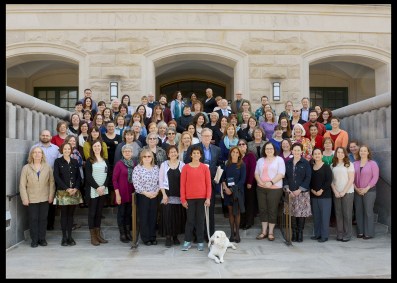
Press Release from The Illinois Library Association
The Illinois State Library is the recipient of the 2016 Illinois Library Association’s Demco Library Innovative Award. This award recognizes a library’s achievement in planning and implementing an innovative or creative program or service, which has had a measurable impact on its users. The award is sponsored by Demco, Inc.
Targeting Autism: A National Forum on Serving Library Patrons on the Spectrum is the product of a National Leadership Grant from the Institute of Museum and Library Services (IMLS). The Grant was earmarked to fund two sessions that would bring together librarians from around the state and experts on library service to people with autism (ASD) with the aim of developing strategies that would improve the ability of all types of libraries to support patrons and families impacted by ASD.
The first forum session held in March, 2015 had over 80 participants. Over a two-day period, presenters informed attendees about the needs of people with ASD and introduced some existing programs and resources. Attendees left the first session armed with information, including two key books on the subjects, and were energized and inspired to go into their own communities, assess needs and begin to offer programs and services locally.
The Forum reconvened in March 2016. Speakers provided more information about ASD and several of the groups presented their findings, which included an identified need for more services for people with ASD transitioning from school to the workforce or adult services. An assistive technology “petting zoo” was offered by students who had collected a wide range of items that would be made available to libraries from around the state. Winners of a newly created grant, Autism Welcome Here: Library Programs Services and More, received their awards and presented their grant-winning projects to those in attendance.
In addition to the Autism Welcome Here Grants, the work of the Forum identified the need for training of librarians. To meet this need, the Illinois State Library applied and was awarded the IMLS Laura Bush 21st Century Librarian Grant. These funds will allow the state library to administer a training program for librarians that will result in improved library service and programs for the ASD community.
The targeting Autism Forum was a first-of-its-kind in the nation. The project addresses a key issue faced by all libraries (with the incidence of ASD now at one in 68, every library is now encountering patrons with this disability) and its potential impact is enormous and far-reaching. The Forum helped create standard of training and service for the state of Illinois that can and most likely will be replicated in other states.
The Demco Library Innovative Award will be presented at the Awards Luncheon held on Tuesday, October 18th during the 2016 ILA Annual Conference in Rosemont.
Private email list/support group for librarians and library paraprofessionals on the spectrum seeking employment
Those of us involved in the Targeting Autism initiative regularly receive emails and phone calls from librarians on the autism spectrum who currently have or have had difficulty finding employment. These individuals include non-degreed as well as those with masters degrees from accredited library schools, who are clearly qualified for professional library employment. Many have received some job interview coaching, but are still unsuccessful at finding a job that exploits their training, knowledge and skills.
If you or someone you know has experienced difficulty finding a job or having a successful job interview due to their autism spectrum disorder and would like to join a private email discussion and support group, I would like to hear from you.
If you are a librarian with autism, your willingness to mentor incoming librarians or paraprofessional library workers is greatly needed.
Finally, if you are not on the autism spectrum, but are an advocate for libraries and librarians with autism, your support is also needed.
For all of you who are willing to contribute to a closed/private online discussion and support group, please send a separate email to Suzanne Schriar to let me know of your interest.
Please consider adding your support to this important and much needed effort.
Thank you!
Connecting with ASD Patrons
The following information is taken from: People with Autism Spectrum Disorders (ASD): What You Need to Know Library Accessibility Tip Sheet 6
A patron with ASD may not be verbal or may talk at you rather than converse. This patron may repeat what you say, be too loud, interrupt others, not understand figures of speech or jokes, and/or be unable to follow multipart instructions. A person with ASD may be unusually sensitive to smells, ambient noise, flickering lights, and certain textures. Many persons with ASD lack the ability to read body language or other social cues. Some persons are not aware of socially appropriate behaviors—not understanding the rules of social distance, appropriate touch, turn taking, and eye contact. These impairments create a need for control and predictability in the environment. Accommodating a person with ASD often involves facilitating and directing interactions in order to reduce the risk of meltdown and disruption.
Following these guidelines will make the library visit comfortable and minimize frustration for persons with ASD. However, if a patron with ASD begins to tantrum (have a meltdown) or becomes verbally or physically threatening, it is OK to ask this person to leave (or have this person removed) until calm. In extreme cases, if the person with ASD represents a threat to himself or others, it is appropriate to involve security personnel or the police. Ensure that law enforcement personnel understand that this person has a developmental disability and is not a criminal.
Patrons with ASD are members of the community and are able to participate in many library programs when given the appropriate supports. The time that you spend creating a comfortable environment will encourage all families to visit their local library.
Tips—General
- Communicate directly with the patron when possible, not the caregiver.
- Determine the preferred communication style (verbal, sign language, written notes, a communication board), and defer to that preference.
- Keep your language simple and concrete. Avoid idioms and multipart directions
- Rather than telling a patron with ASD what not to do, instead be positive, advising the patron about acceptable behavior.
- Be predictable. Describe your present and upcoming actions.
- Give five- or ten-minute warnings before transitions (for example, the end of computer time).
- Do not insist on adherence to social norms, such as eye contact.
- Be flexible. Allow some noisemaking, gum chewing, and sitting where comfortable to encourage participation if these things help the person with ASD organize him- or herself and participate.
- Bend circulation policies when possible. (For example, allow multiple renewals of favorite titles.)
- If waiting in line is a problem for a person with ASD, assist the person with ASD as soon as feasible. Do this in a discreet manner; do not to draw attention to the patron.
- Minimize sensory stimulation. For example, turn off some fluorescent lights and remove distracting objects from program rooms.
- Provide quiet, private work areas.
- Explain environmental changes, including furniture or staff changes, to patrons.
- Ask patrons what disturbs the library environment, and avoid or alter these environmental stresses.
- Advise patrons with ASD of days and times when noise/crowding is lower and staff can provide greater personal assistance.
- Have a quiet place where someone can go to compose him- or herself if necessary.
Tips—Class Visits or Programs
- Unless told otherwise, assume that a child with ASD is functioning on the same age/grade level as peers.
- Begin with an explanation of the visit or program with a visual schedule. Refer to that schedule when transitioning to a new activity.
- Don’t insist that the child with ASD join in everything, but be prepared to adapt activities or crafts so children with ASD can participate.
Assistive Technology
- Picture schedules of library events or due dates of materials.
- Visual timers where needed.
- Touch screens
- Alpha smart (a lightweight, portable tool which helps persons who have difficulty with spelling and grammar get it right)
- Fidgets (small manipulatives like a soft ball or anything that fits safely and comfortably in the hand)
- Natural light or full-spectrum florescent lighting
What people have said about the Targeting Autism Forum

Below is a small sample of the comments received by the University of Illinois Research Office from a survey of Targeting Autism forum attendees:
“All the formal presentations were fantastic, inspiring, enlightening, engaging–I can’t say enough! But I also want to note that the informal in-between times, chatting with people at our tables, was extremely valuable in terms of sharing ideas and inspiration, making connections and discovering new resources. Thanks for getting so many great brains in one place!”
“…Such a wealth of information and ideas is an amazing thing to be a part of to help me grow personally and professionally in the library system…”
“…I am now more likely to take proactive steps on behalf of our library serving people on the spectrum. It was especially inspirational meeting people on the spectrum…”
“The forum in March 2016 was very instrumental to not just myself but several other southern Illinois librarians who attended. The smaller populations and budgets of our libraries make it more difficult to provide services and information to our patrons. The March 2016 Forum demonstrated that every library can be autism aware and proactibely work toward making its staff and programs ASD friendly. The awareness that the southern Illinois librarians gained from the forum is just the beginning of a change in the way we understand and provide services for our ASD patrons.”
“Even though I am the parent of two teens with ASD and a former Special Ed teacher, I struggled with knowing what accommodations were needed and how to implement them. Some of this struggle can be attributed to lack of understanding from my superiors. So, the fact that a forum on just this one topic was offered combined with my interest and excitement afterwards has changed the level of resistance. Now I have great examples of what is needed and can be done in a library .”
“I see the library as a great community resource to offer services in a neutral, non-stigmatized setting. A place for integrated activities to build awareness and acceptance of people of all abilities.”
“I think it’s a wonderful opportunity for people on the spectrum, their families and the entire community! It’s something that needed to have happened a very long time ago. I’m just pleased to see that it is finally happening!”
“…It’s [the forum] expanded the idea of what kind of resource the library can be for families living with autism, and helped me appreciate the importance of serving patrons throughout the transitions in their lives, from child to teen to adult.”
“It [the forum] has helped me realize the value of our service to individuals with ASD. Being a relatively small library, we are the only real resource for these individuals and their families.”
“It has helped to reinforce the idea that as a community center the library can be the perfect place to promote awareness, acceptance, inclusion and help to move others to this perspective.”
“The Forum has helped me understand that libraries should be the place where people libing on the spectrum are welcome and able to experience new assistive technology like the apps and social robots.”
“I learned a very valuable life lesson while listening to the speakers. We all have behaviors/characteristics that could be ASD. Most of us learn to compensate for those behaviors. For that one person in sixty-eight who can’t compensate, we as libraries need to step forward, make accommodations, and let our patrons know that libraries are for everyone.”
“The forum helped me to understand the important role of the library as community center for all people. I learned so much and would love for my coworkers to have some of this information to give them a better understanding and awareness of people on the spectrum and their families. I am happy to share with them the things that I have learned, but I feel it would be important for them to have more first-hand experience with people on the spectrum as well as training by professionals in the field.”
“…Libraries can be leaders in the field of inclusion and accessibility for people with ASD. And this forum opened my eyes to what potential impact libraries could have across the state if we unify, are trained, and collaborate. Thank you ISL!”
The next Targeting Autism forum will take place in April 2017. Please send any additional comments and suggestions for next year’s event to Suzanne Schriar.
Targeting Autism Forum Survey Results Reveal the Educational Impact of ASD Self-Advocates
The University of Illinois Springfield’s Survey Research Office conducted a survey of forum participants to find out what content and which speakers made the biggest impact at the March 2016 event. Overwhelmingly, those who attended reported that they gained the most knowledge from self-advocates who spoke at the forum.


The ASD self-advocates who spoke at this year’s forum included (from left to right) Marty Murphy, national public speaker and author; Adria Nassim, consultant, speaker and founder of Adria’s Village; and Alex Dudzenski and Hayden Davis, two middle who, with the help of their teacher, Jan Abernathy, host a YouTube series where they interview guests, showcase pets and share interesting facts about autism.
All presentations from both the 2015 and 2016 Targeting Autism forums can be viewed on the Targeting Autism YouTube channel.
We are seeking suggestions for speakers at the 2017 Targeting Autism forum. If you have ideas, please post a comment to the blog or send an email to Suzanne Schriar
 targetingautismlibs.com