Uncategorized
Grant Awarded to Albert Wisner Public Library to Serve Teens with Autism
The “Autism Welcome Here: Library Programs, Services and More” Grant Committee is proud to announce the Albert Wisner Public Library in Warwick, New York as this year’s grant recipient. As the winner of this grant, the library will receive $5000 for their project “Improve Your Social Life: Social Skills for Tweens and Teens with Autism.”
The “Autism Welcome Here: Library Programs, Services and More” Grant is sponsored by Libraries and Autism: We’re Connected (www.librariesandautism.org). This grant honors the memory of Meg Kolaya and her groundbreaking work as co-founder of Libraries and Autism, as well as her contributions in promoting inclusion, connecting libraries and the autism community, and bringing awareness to the needs of individuals with Autism Spectrum Disorder (ASD).
The Albert Wisner Public Library will provide a series of workshops designed to support the development of social skills for teens and tweens with ASD. In this series, participants will have the opportunity to learn about the library, form a book group, enhance their social media etiquette, express themselves through art projects, play board games, take part in a group dance, and more. The program has three primary goals: introduce and encourage social skills that teens and tweens can apply in the library and beyond; provide those on the spectrum and their families a safe and familiar place in the community; demonstrate respect for neurodiversity and inclusion.
Barbara Klipper, creator of the grant said, “I am delighted that this year’s grant winner is Albert Wisner Public Library. Their parent-initiated proposal was well-written, is easily replicable and serves an often overlooked subgroup of the ASD population. In 2016, we funded projects for preschoolers and for college students. This year, we are funding an initiative for tweens and teens. It is my hope that these grant-winning projects will inspire a wide range of libraries to serve people of all ages with ASD.”
Daniel F. Flores, Ph.D. is from the Judith J. Carrier Library at Tarrant County College in Texas, one of the recipients of last year’s “Autism Welcome Here” Grant. The college developed a new project to support a successful transition to college students with ASD. When asked about the impact this grant had on his college community, Flores said, “I am thankful for the Autism Welcome Here Grant. Our Autism Spectrum College Information Talks Project at Tarrant County College offers expert-led forums designed around the research question—how can we facilitate a successful transition to college for students with ASD? My own awareness of students with ASD has grown immensely, and this experience has opened my eyes to the amazing capabilities and gifts of college students with ASD.”
The “Autism Welcome Here: Library Programs, Services, and More” Grant Committee extends their congratulations to Albert Wisner Public Library and to all of the libraries that submitted proposals.
Applications for the 2018 grant(s) will be accepted starting September 1, 2017. More information about the grant can be found at www.librariesandautism.org/grant.
Members of the 2017 “Autism Welcome Here: Library Programs, Services, and More” Grant Committee include Daniel Flores (2017); Renee Grassi (2016, 2017); Barbara Klipper (2016, 2017); Adria Nassim (2016, 2017); Suzanne Schriar (2016, 2017); Debra Vines (2016, 2017); and Dan Weiss (2016, 2017).
Targeting Autism in Communities of Color

Debra Vines, Founder/Executive Director of The Answer Inc. and Targeting Autism board member discusses the challenges faced by her community in accessing autism support and services in an interview with ABC News Correspondent, John Donvan.
White Paper Describes the Impact of the Targeting Autism National Forums
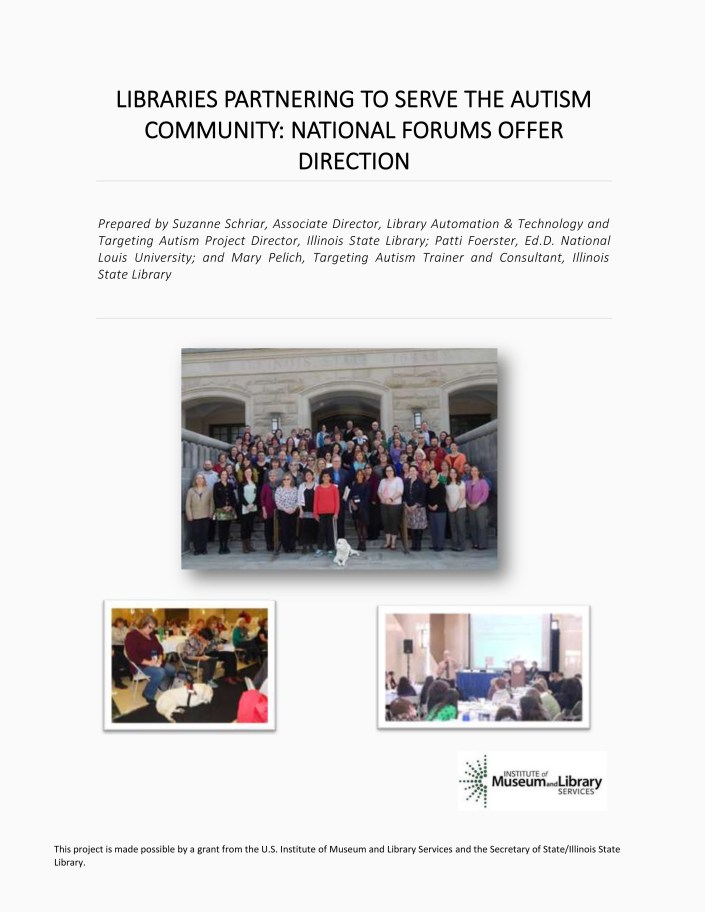
Libraries Partnering to Serve the Autism Community: National Forums Offer Direction is the result of two national forums that were convened at the Illinois State Library in 2015 and 2016. The forums, which were funded through the National Leadership Grant (NLG) Program of the Institute of Museum and Library Services (IMLS), exposed the need for libraries throughout Illinois and across the nation to better serve patrons and families affected by autism.
The entire report is available here.
Targeting 2017 as an auspicious year for all!!!

If 2016 has been challenging, the New Year always brings us the promise of starting afresh. We take time to reflect, evaluate priorities and set new goals. Make one of your resolutions for the New Year to become more active in the discussions about autism and inclusive communities. Join our discussion list and share your insights. Add your personal experiences to the rich dialogue. Each of us has a responsibility to engage with our communities. Embracing diversity demands open dialogue. Even the smallest attempt to engage can spark positive change in our world. In 2017, let’s make a commitment to break down the barriers that divide us. We can begin with a conversation.
Taking Care of Yourself During the Holiday Season
Many people are unaware that sensory overload affects adults with autism as well as children. Adults can still experience anxiety, panic, even meltdowns when sensory stimuli becomes just too much. The holidays can be extremely difficult for children and adults with heightened sensitivities because the environment is so charged with sensory stimuli – malls are crowded, traffic is backed up, lights are twinkling, stores are noisy. The social anxiety that often accompanies autism can also make holiday office parties and family gatherings even more stressful.
Here’s how to cope:
Know Thyself:
First, know yourself and your limitations. Being aware of your sensory triggers will help you to avoid or minimize them in many situations. It’s also important to think about what soothes you. What makes you feel safe? What helps calm you? Where is your favorite “feel-good” place? These calming mechanisms can be used as a tool when you’re feeling overwhelmed.
Managing crowds:
If you have shopping to do, go at non-peak times – early in the morning or very late at night. Most stores have extended hours throughout the holiday season that makes this possible. Consider using Uber or public transportation to avoid the hassles of bumper-to-bumper traffic. If music calms you, listen to your own tracks through headphones or earbuds while you shop.
Think about where you’re going ahead of time. Is there a quiet bookstore or coffee shop nearby to offer a less stimulating environment if you get stressed? Eat before you leave or bring snacks with you. Everyone gets more stressed-out when they’re hungry! Plan for breaks and know when enough is enough. When you start to feel overwhelmed – STOP. Go home or to your soothing spot to reset.
Handling anxiety:
If you need to self-soothe – do it! Wear a chewable necklace, bring a fidget in your pocket. Being able to calm yourself is more important than any perceptions that others might have of you.
Social situations:
Plan ahead – if you know the physical layout, identify a quiet room that you can go to when you get overstimulated. Be open with family and friends about how social situations make you feel. Is there a trusted sibling or friend that can be your “sensory coach” if things get overwhelming? Can you develop a cue or code for a break? If possible, take a walk outside when it gets to be too much. Set a time limit for the office party and try to stick to it. If you feel yourself shutting down or getting overwhelmed, take a break, go to a quiet spot or leave if you need to.
Let’s face it, we all get overwhelmed sometimes. Sensory overload happens to all of us – times when we feel we feel like we’re going to implode, explode or just need to shut down. During the holiday season, we all need to take a step back, be sensitive, take care of ourselves and take extra care of our loved ones and friends, especially those who have heightened sensitivities.
Follow our blog and join the discussion list for more tips and help.
 targetingautismlibs.com